

If you work for a multinational in Ireland, there’s a good chance part of your pay doesn’t just arrive in cash. Instead, it arrives in company shares, often termed RSUs.
Twenty years ago, this was relatively uncommon outside senior management. Today, stock awards have become a standard part of remuneration across many multinational employers, particularly in technology and pharmaceuticals. As the multinational sector has expanded, so too has the number of Irish employees building significant wealth through company shares.
Over 25% of private sector employees in Ireland now work for foreign-owned multinationals, according to the CSO. For many of these workers, receiving Restricted Stock Units (RSUs) or other stock awards is part of the package.
But once those shares vest, an important question arises: how much company stock should you actually hold?
What’s an RSU?
A Restricted Stock Unit, or RSU, is a promise by your employer to give you shares, usually over a number of years provided you remain with the company. Once the shares vest, they’re yours. You’ll typically pay Income Tax, USC and PRSI when they vest, after which you can decide whether to keep the shares or sell them.
RSUs have largely replaced stock options as a way to reward employees of multinationals in Ireland.
Many people treat RSUs as just another investment. But they’re different. They represent an investment in the same company that’s already paying your salary.
The case for holding on
There are good reasons why employees decide to keep their all of their shares.
For one thing, you know the business well. You understand its products, culture and strategy better than the average investor. It can also feel rewarding to own part of the company you’re helping to build.
And sometimes, holding on works out extremely well. Employees at companies that have gone on to deliver exceptional long-term growth have been handsomely rewarded for their patience.
The risks are easy to underestimate
The difficulty is that your career and your investments become tied to the same outcome.
If your employer runs into difficulties, it’s not just your share portfolio that may suffer. Your bonus, future RSU awards and even your job security could all be affected at the same time.
Just think of the employees in banks in Ireland and elsewhere during the financial crisis who chose to take their bonuses in shares – and then watched those shares fall by 99% of more. Just at the time their jobs were under pressure, their stock investments vanished in value.
There’s another consideration: your pensions. If you work in technology, it’s likely your pension is also heavily invested in global equity markets where the same large technology companies already feature prominently. Without realising it, you will have multiple layers of exposure to the same theme.
Ask yourself: if you didn’t work the company, would you really invest – say – half your wealth in their shares alone?
RSUs add volatility to your investment holdings
By definition, when you hold RSUs, you’re increasing single-stock exposure your portfolio. It’s likely to move (up or down) more sharply than a broader fund holding, as the chart shows.
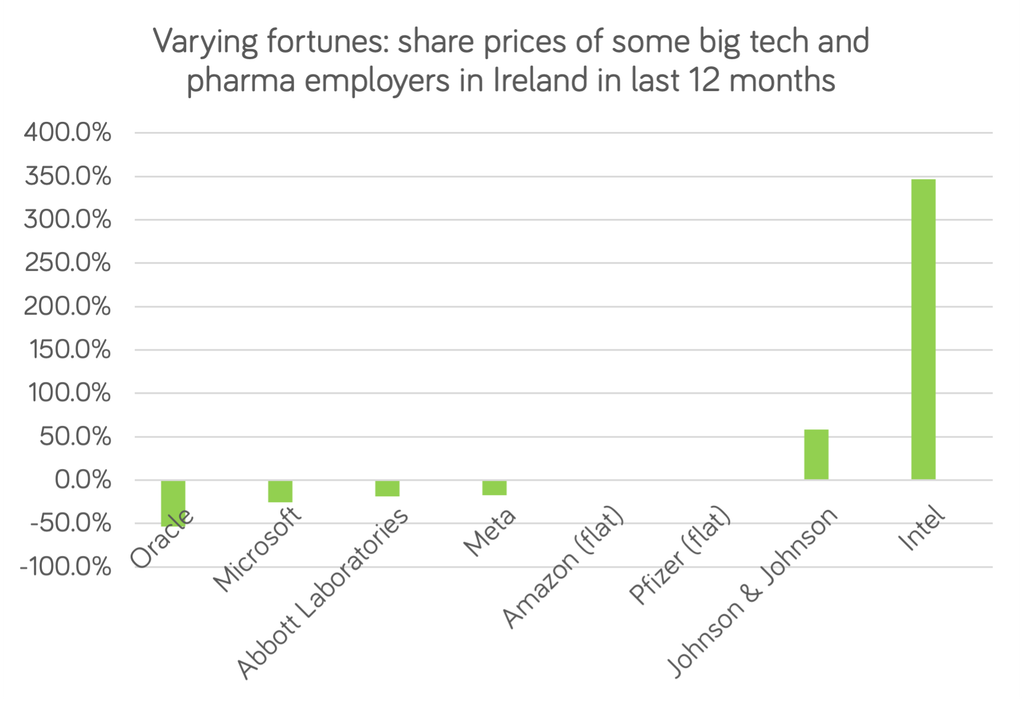
Note: chart displays share price movement over the 12 months to 24 July 2026
Source: Google Finance
Employees of technology businesses, where equity compensation is commonplace, have experienced this more than most over recent years, as artificial intelligence reshapes markets.
Recent performance illustrates the point. Over the last year, Oracle has fallen around 54%, Microsoft around 25% and Meta around 17%, while Amazon has been broadly flat.
Yet the opposite can also happen. Intel lost roughly two-thirds of its value during the four years to mid-2025 before rebounding by around 350% over the following year, rewarding those who stayed the course.
Holding company shares can also reduce your flexibility. If your employer is unlisted, there may only be occasional opportunities to sell. Even listed companies often restrict dealing to specific trading windows, limiting your ability to access your money when you’d like.
Set a target
So while RSUs and stock options can be a valuable benefit, it’s wise to consider the extent of your exposure.
That doesn’t necessarily mean selling every share the moment it vests. It does mean recognising that company stock isn’t just another investment. It’s already closely linked to your financial future. What’s more, if you stay employed at the firm, it’s likely you’re on a timeline for future stock units to vest.
It helps to set a clear target.
For example, you might decide that company shares should represent no more than 10% or 20% of your total investible wealth. If strong share price performance pushes your holding above that level, you can sell enough shares to return to your target and reinvest the proceeds into a diversified portfolio of global investments.
You could set a timetable to sell down to the target allocation in several trades over time.
This approach removes much of the guesswork. You’re not trying to predict whether your employer’s shares will rise or fall next month. You’re managing the concentration risk while still participating in the business’s success.