

The AI story has come to dominate investment markets. Every week brings another eye-watering valuation, a GUBU twist in the Nvidia tale, or a multi-billion-dollar deal. For investors, it can feel as though the only place to be is in AI.
But what if you don’t want to be there? What if you are wary of the valuations, sceptical about some of the promises or simply don’t enjoy the drama?
There are perfectly good reasons to take a step back. AI may well prove to be one of the defining technologies of our time, but it is crowding out other growth stories, and has come to dominate some investors’ portfolios.
Has the big money in AI already been made?
There are also growing questions about the financial foundations of the AI boom, and a concern that the big money in artificial intelligence has already been made.
Some of the industry’s biggest players are striking complex deals with one another, raising concerns about circular financing and how much underlying demand is really being created. Huge investment commitments, sometimes involving off-balance-sheet arrangements, make it harder to assess the true financial exposure. Debt levels are rising. And the technology itself carries risks: today’s expensive infrastructure risks becoming tomorrow’s obsolete equipment if computing costs fall, better technologies emerge, or businesses are happy to pay lower rates for older AI models.
Then there are the ethical considerations. From the energy and water required to power data centres to concerns about employment, privacy, copyright and the concentration of technological power, not to mention the potential consequences of unconstrained AI agents, not everyone is comfortable with the direction of travel.
Where can investors look instead?
The good news is that there is more to the investment world than Silicon Valley. And investors needn’t sacrifice growth to reduce AI exposure. In fact, some growth opportunities have not received the attention they deserve while tech firms dominate the headlines.
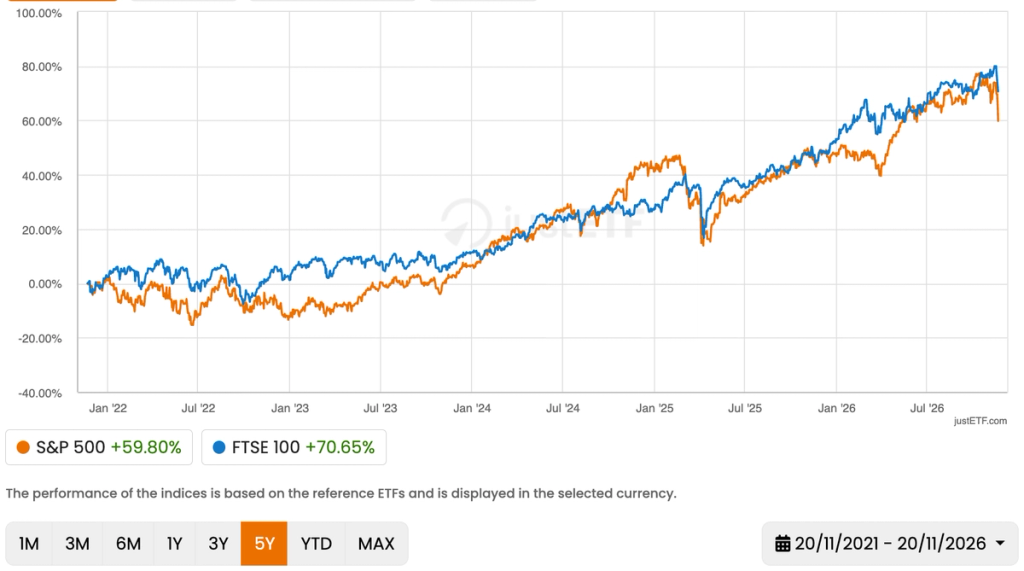
Take the UK stock market for example. In Euro terms, a FTSE 100 ETF has now outperformed an S&P 500 one over one-, three- and six-month periods, as well as over one, three and five years, as the chart below from JustEFT shows.
The UK market offers exposure to areas such as financial services, energy, mining, consumer goods and pharmaceuticals. None of these industries are disappearing anytime soon. Its constituents are generally established businesses with global revenues, strong cash flows and the potential to benefit from long-term economic growth.
Japanese equites are similarly overlooked. Less AI-dominated than the US market, it nonetheless offers useful exposures to similar themes like industrial automation, digitisation and robotics. An index fund tracking the Japanese market is up circa 15% in 2026 so far, compared to around 11% from the US market.
Tech is more than AI
There is also no need to rule out every big technology company. Companies such as Apple and Microsoft offer exposure to established technology businesses, with substantial customer bases, recurring revenues and diversified product offerings.
Neither is an AI-free investment, of course, but there is a distinction between owning a diversified technology business and building a portfolio around the most speculative parts of the AI trade.
Think beyond shares
It’s also worth looking outside conventional equities altogether.
Commodities have been an important source of growth and balance in a portfolio in recent years, for example.
And investing in infrastructure is a key opportunity for investors seeking exposure to long-term structural growth, and more predictable earnings.
Energy networks, water utilities, transport systems and other essential services require substantial ongoing investment. Demand for these assets is driven by population growth, urbanisation, the energy transition and the need to modernise ageing infrastructure. These are long-term investment themes that depend little on the success of generative AI.
BlackRock Global Listed Infrastructure Fund, for example, available through Standard Life’s platform, is up almost 18% so far this year, while 3i Infrastructure is up around 12% in Euro terms over the same period.
There’s life beyond AI
Constructing a completely AI-free portfolio is probably impossible. Almost every business on the planet is now exploring how it can use the technology.
But that is not the same as having to buy into the AI investment story at any price.
A portfolio built around established businesses, international diversification, infrastructure and a broader range of industries can still offer plenty of growth potential. It may also avoid some of the concentration risk and valuation anxiety that come with AI holdings right now.
You don’t have to be anti-AI to decide that you have enough of it in your portfolio. Sometimes, the most interesting investment opportunities are the ones everyone else has stopped talking about.