

Welcome to Moneycube’s annual roundup of the best investments available in Ireland.
We’ve chosen five funds we think have strong potential for the year ahead in the wake of a choppy 2025. Halfway through the decade, investors have had a few shocks – and plenty of investment growth. But while there’s growth to be had, it’s unlikely to become plain sailing anytime soon. If you’re looking to invest money in Ireland, read on.
Whether you’re a new investor, or looking to invest a large lump sum, we’ve got a fund for you.
We’ve also crunched the numbers to identify our two favourite global equities funds for Ireland-based investors in 2026, and included a suggestion on a alternative funds that could provide useful specialist exposure in larger portfolios.
Remember, these funds are all available through Moneycube, along with many more. But a word of warning at the start: everyone’s circumstances are different. We’d love to hear about your detailed requirements and advise you on what’s appropriate for your situation.
Three themes for the year ahead
In our market outlook for 2026, we highlighted three themes investors can expect in the year ahead:
- We’ll start to see winners and losers from the AI mega trend;
- There are strong reasons to diversify from the US, into Europe and emerging markets;
- Alternatives can offer balance, from precious metals to commodities and real assets like infrastructure and property.
There is a sense of momentum in markets as the year begins, but there are many factors (such as geopolitical surprises) which could throw individual sectors off course. More than usual, it seems wise to spread one’s exposure. As ever, if you invest in a diversified and measured way – as Moneycube customers do – there will be significant opportunities for investment growth.
Finally, there’s also a need to stay the course. Investing’s a long-term game. So we’ve shared some ideas on equity funds for the long term – perhaps via a regular monthly investment.
This might all sound great in theory, but how does it look in practice? We’ve taken a look at how €20,000 invested a year ago in our 2025 selections performed here.
In fact, you’ll find there’s a quite a lot of continuity between our 2025 choices (and our 2024 choices), and this year’s. That’s just as it should be, because investing’s a long term game. At the same time, we’ve also introduced some new funds which have proven their worth in the new economic environment we’re in.
Best fund for new investors looking to invest money in Ireland
Moneycube believes multi-asset funds should lie at the centre of most investors’ portfolios.
Whether you are investing a lump sum, setting up a regular investment, or both, multi-asset funds are useful. In a single fund, you can achieve the diversification, flexibility and balanced growth potential that most people need from their wealth.
For new investors, we’re sticking with a long-standing choice. Zurich’s Prisma range is a strong option for many who want to invest money in Ireland. We’ll focus on Prisma 4 here, as it’s a balanced, mid-risk fund suitable for many investors.
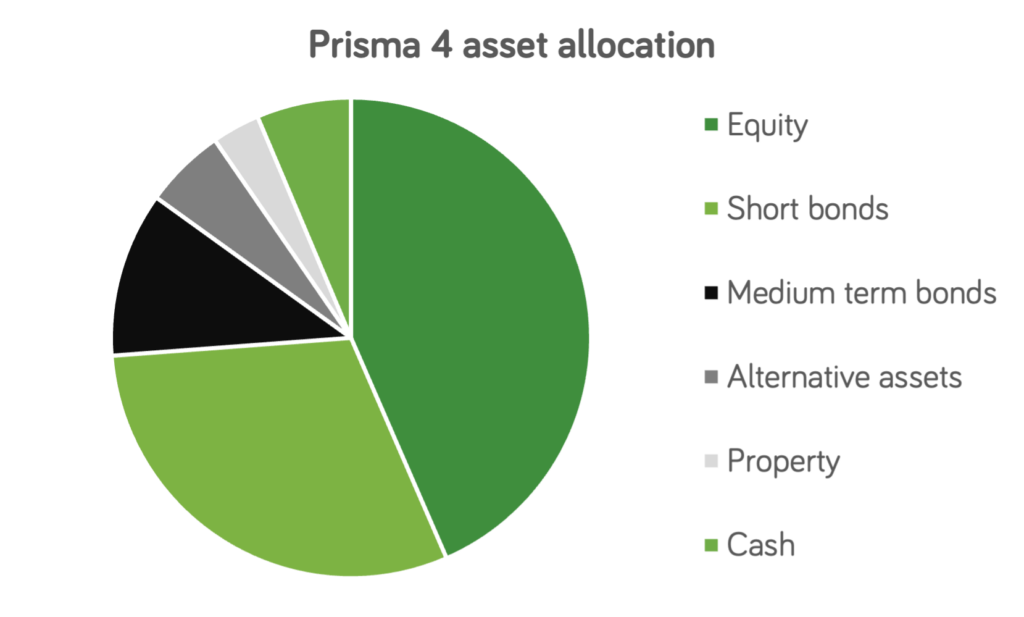
As the chart shows, it gives exposure to a broad range of assets, split among equites (43%), bonds (41%), alternative assets including gold and commodities (5%), property (3%), and a relatively high allocation to cash at 6%, which the managers can deploy to take advantage of short-term pricing mismatches.
Prisma 4 is also spread over the globe, but it has been reducing its North America exposure. 69% of the fund is invested in the US and Canada, compared to 74% one year ago. Twelve months ago just 12% of the fund was invested in Europe. That figure has now moved to 18%.
A further 6% is invested in Japan, and 7% in wider Asia-Pacific.
As we enter the year, the level of equity within the fund has reduced from 45% a year ago to 43% today, while allocations to short bonds/ cash have grown.
More importantly, it has a long-term track record of on-track returns, delivering on average 6.6% since its launch ten years ago.
In the last five years (to January 2025), this fund has returned 40.9% total growth as this chart shows.
In fact, Zurich Prisma 4’s performance is substantially better than comparable funds from its competitors at Irish Life, New Ireland, and Standard Life over the last three and the last five years.
Here’s a comparison:
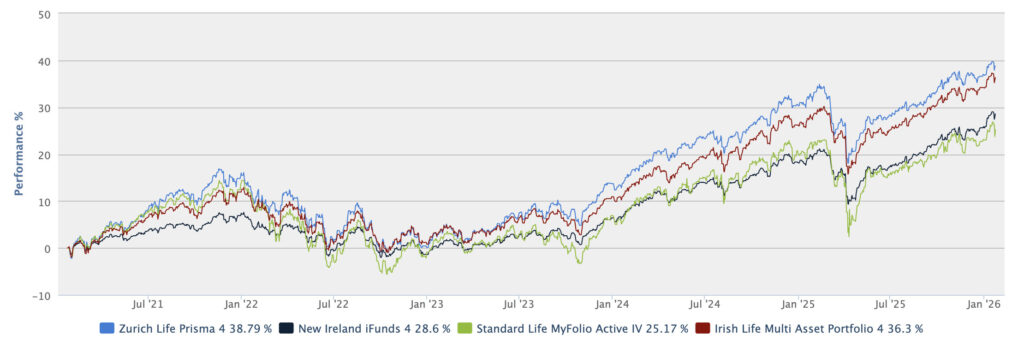
Source: Longboat Analytics; data for the five years to 23 Jan 26
For contrast, your money in the bank has earned less than 1% in interest during the same period.
For some investors, this equity allocation will be too low. In that case, it’s worth considering Aviva’s index-based Fixed ESG range. Their Fixed ESG 60 fund – the nearest comparison to Prisma 4 – rebalances on a monthly basis to 60% equity and 40% bonds.
Like Prisma 4, Fixed ESG 60 has an average annualised growth rate of 11% over the last three years.
Aviva’s index-based approach also means this fund range tends to be around 0.1% lower cost than many comparable rivals.
Best funds for larger lump sums when you invest in Ireland
If you have a lump sum of around €75,000 or higher, it’s time to consider using Moneycube to build your own portfolio.
If you’re willing to handle your own tax affairs, you can open a much wider world of fund options, and significantly drive down your overall cost of investing.
We generally recommend a portfolio of at least five such funds. So it’s impossible to pick a single fund in this category. But the purpose of a portfolio approach is to diversify, and in 2026, US markets present increasing risk to Eurozone-based investors. So here are two of our picks for European and emerging markets exposure.
Best fund for European equities
In Europe, JPMorgan European Growth and Income looks a solid pick. It holds a fairly uncontroversial selection of world-beating European companies, from Dutch semiconductor machine maker ASML to Swiss pharma leaders Novartis and Roche, financial services leaders and global industrial leaders like Siemens.
JEGI had a belter of a 2025, up 40% in Euro terms. But more importantly, it has an average annual growth rate of 21.6% over the last five years.
In emerging markets, it’s often said it pays to be discriminating. Buying the index is simply more risky in some emerging markets, where governments can exert a high degree of control over economies, and markets are generally less liquid.
Best fund for Emerging markets
Our emerging markets fund of choice is Templeton Emerging Markets. Europe’s story is about investment, recovery and self reliance. In emerging markets, the narrative is much more concerned with growth. There are plenty of tailwinds, from rising commodity prices, world-beating companies in China, India, South Korea and elsewhere, to increased trade as the US pursues its America First agenda, to a falling US dollar which supporting emerging market exports and debt costs.
You can read more about our approach to investing larger lump sums here.
Two of the best pure equity funds for long-term investors
Long-term investors can afford ride out short-term market dips. That means they can take more risk with their money, to create the potential for better growth. We’ve selected two funds to fit this bill. As it’s long term, and the returns speak for themselves, both are funds we’ve looked at in the past as among the best place to invest money in Ireland.
One is actively managed in Dublin. The other is a pure passive solution from global leaders Vanguard.
Index investing with Vanguard
If you simply want a slice of what is going on in companies all around the world, a ready-made portfolio from Vanguard might be for you. Using this route, we’ll help you invest into four index funds, giving you exposure to the US S&P 500, and major European, Japanese, and emerging market stocks.
It’s hard to beat this approach for diversification among companies. Taken together, this portfolio holds positions in over 2,700 companies. And it has delivered average annual growth of 12.4% over the last five years.
You can read all about Vanguard and index fund investing here.
Active management with Aviva Investors
If you’re contemplating investing a large lump sum there are also a number of funds which have proven their ability to deliver in many different market conditions through active stockpicking. One such is Aviva High Yield Equity, which we first mentioned in 2020.
This fund (which reinvests dividends received) has delivered more than 12% average annual growth over the last three, five and ten year periods.
In that context, 2025 was disappointing: a return of 3.8%. Our view is that this fund is poised for a return to form. Its relatively low US exposure at 45%, its exposures to European and Asian winners, for example Axa and AIA in financial services, its holdings in AI winners Alphabet and Broadcom, and its focus on companies providing a real cash return in the form of dividends to shareholders should stand it in good stead.
We also continue to like Aviva High Yield Equity for its flexibility, its fees, and its performance. You can invest a lump sum, a regular direct debit, or both. It’s available via Moneycube for an annual management charge of 1.25%, including the cost of financial advice.
In general, funds like this are invested in international businesses with strong brands and pricing power.
Whatever the weather, funds like this are a suitable home for many people investing their money in Ireland, perhaps coupled with the Fixed ESG range described above.
Where next for alternative asset exposure?
More than most years, diversifying seems necessary in 2026. Getting a strong return is no longer as simple as buying a slug of the S&P500 and forgetting about it. In fact, that US index returned only 3.5% to Eurozone investors during 2025 – and the trends that caused that seem likely to be with us for some time.
Gold is the obvious alternative – and one we highlighted early last year. But having risen 45% in 2025 and surpassed $5,000 in January of this year, its upward rise cannot continue forever. Many investors will want to review their exposure as a proportion of their portfolio, and perhaps take some profits.
The broader lesson still applies: in the times we are in, it pays to be heavily diversified. It’s worth considering if there is a place in your portfolio for alternatives like infrastructure, private equity (our tip last year, CT Private Equity, rose 40%), and commodities.
Next steps
At Moneycube, we know everyone’s circumstances are different. The best place to investment money in Ireland for you right now might well be different from the funds we’ve highlighted above. But with more than 10,000 funds at our fingertips, we’re confident we can find a fund to suit you.
We hope these ideas will give you a starting point to invest money in Ireland in 2026. Now you can get in touch, to design an investment plan that’s right for you.